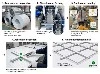


Selecting suitable fiberglass products requires evaluating four key dimensions-performance specifications, compliance certifications, appearance and workmanship, and application suitability-to ensure the chosen product meets both practical needs and quality standards.
Type Classification: First, distinguish between fiberglass material types (e.g., E-grade general-purpose, S-grade high-strength, or C-grade chemical-resistant fiberglass) and product forms (such as chopped strands, continuous filament yarn, fiberglass cloth, fiberglass mat, or thermal insulation boards), as different types are suited to vastly different applications;
Performance Specifications: Focus on verifying parameters such as tensile strength, temperature resistance range, acid/alkali corrosion resistance, and water absorption, ensuring they align with the specific requirements of the intended application;
Compliance Standards: Confirm that the product meets relevant domestic industry standards; for instance, general-purpose fiberglass must comply with GB/T 18374 (*Terminology for Glass Fiber Reinforced Plastics*), while electronic-grade or food-contact products must additionally meet specific national standards applicable to those categories.