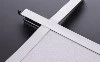


Mineral wool ceiling tiles are typically manufactured through a wet-felting process. In this method, mineral wool, a binder, and various other additives are first mixed together into a dilute aqueous slurry, which is then evenly distributed onto a continuously moving screen. The water is removed in two stages: first by gravity drainage, and then by vacuum suction, which consolidates the mixture into a base mat. This mat is subsequently pressed to achieve the desired thickness, dried in heated ovens to cure the binder and remove remaining moisture, and finally cut to size for installation. The resulting porous structure is key to the tile's acoustic performance, as the interconnected voids trap sound waves and dissipate acoustic energy. To further enhance this effect, chopped glass fibers are sometimes added to promote and maintain voids within the mat, lowering density and improving sound absorption. In addition, finished tiles may be coated, painted, or laminated with a fiberglass scrim to provide a clean, uniform face and to improve durability and appearance.
To further enhance performance and meet diverse application requirements, additional finishing steps are often incorporated. Many tiles receive a factory-applied primer or topcoat to improve light reflectance, resist staining, and create a smooth, uniform surface. Perforated or textured patterns may be embossed or punched into the face to modulate both aesthetics and acoustic behavior. For moisture-prone environments, water-repellent treatments or special coatings can be applied to inhibit sagging and microbial growth. Edge details-such as square, tegular, or beveled profiles-are precisely machined to ensure proper fit within suspension grid systems. High-performance variants may also incorporate sound-absorbing fleece or fabric facings, or be backed with foil to control air leakage and boost low-frequency absorption. Rigorous quality checks on density, thickness, dimensional stability, and fire performance are conducted throughout production before packaging and shipment.